Roots and Salads Experiment – a Quick Update

A few weeks ago, I sowed half of our second raised bed with four blocks of paired root and salad crops. Just a small companion planting experiment to see whether leaf-salad crops (mainly above-ground) and root crops (mainly below ground) can happily share the same space without crowding out the other too badly.

Here are a few shots taken last Saturday to show where they’re up to. Click any of the pics for larger versions:

Block A : beetroot, Boltardy and basil, Sweet

Very little activity here. A few spindly beetroot seedlings (I’ve never had much luck with beetroot) and what are hopefully a lot of tiny basil seedlings, although there’s always a chance they’ll turn out to be weeds. A case of ‘wait and see’ with those…

Roots & Salads block A, June 2013

Block B : radish, Candela di Fuoco and spinach beet, Perpetual

As you can see, easily the most vigorous growth so far. The leaves are similar, but they are different enough to pick out: the spinach beet is rounded, the radish leaves slightly wavy. Plus, the radish has a row of tiny spines running along the back of the leaf, down the central stem – not so nice to eat.

Roots & Salads block B, June 2013

Block C : swede, Ruby and rocket

I think pretty much everything you see in here is rocket, so far. Or maybe swede. Or both. Only one way to check – try some, see if they taste like rocket or not. Serves me right for planting companion plants with similarly-shaped leaves.

Roots & Salads block C, June 2013

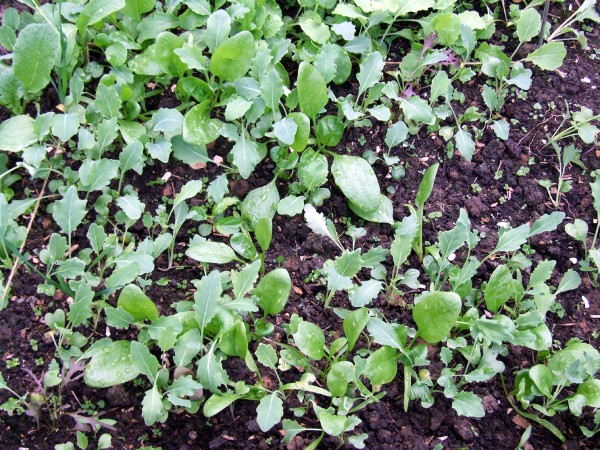
Block D : kohl rabi, Green Delicacy and spinach, El Grinta

Two distinct leaf-shapes here – rounded spinach and crinkly kohl rabi – so no great difficulty telling them apart. I picked a few spinach leaves at the weekend and very tasty they were, too. And I know from last year that young kohl rabi leaves have a lovely, nutty flavour as well, so if I have to thin a few of those as I go, that’ll be just fine.

Roots & Salads block D, June 2013

So: mixed results so far. Not much happening in block A (maybe basil needs more heat to get going), a minor case of foliage-confusion in block C, but blocks B and D are producing tasty salad leaves around four weeks from planting, and with any luck their root-oriented companions will be growing nicely as well.

This Year’s Runner Bean Frame Goes In

Constructing the climbing frame for the runner beans is always one of my favourite garden mini-projects.

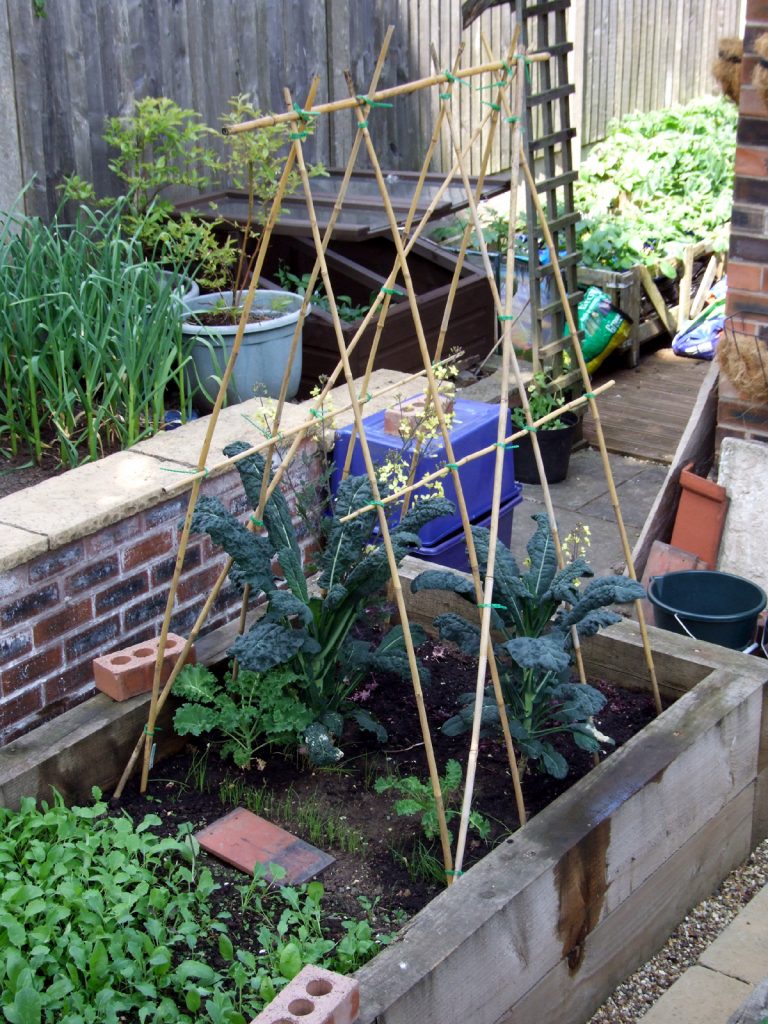
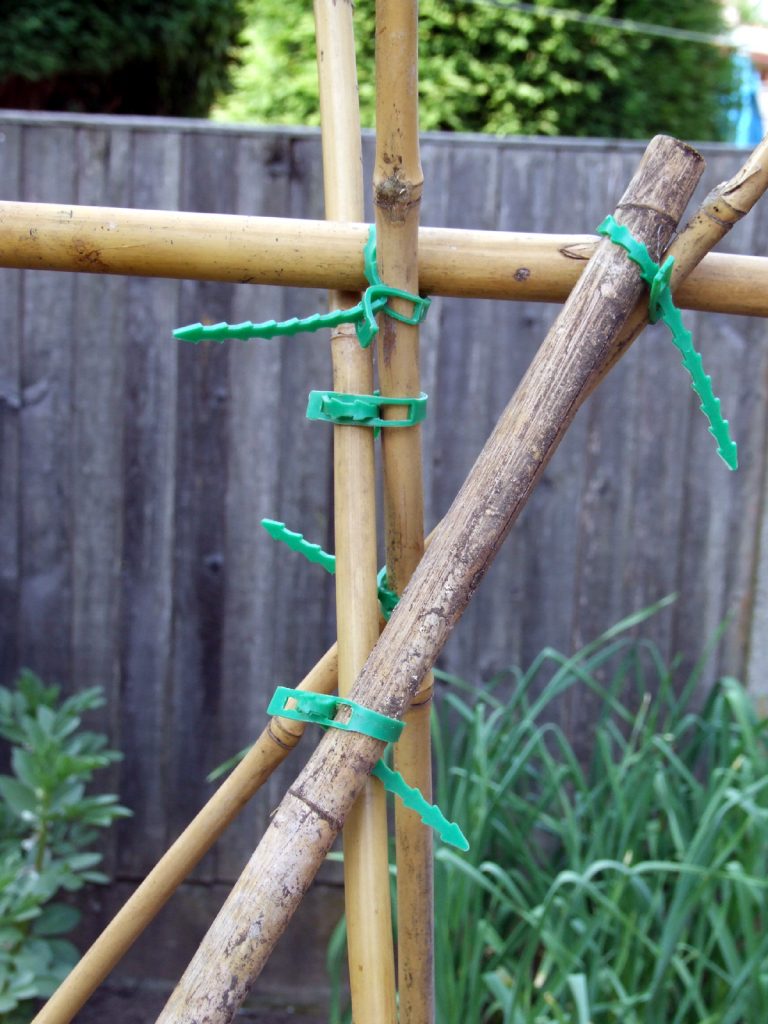
In the past I’ve tried a couple of configurations in an attempt to maximise light and air access, but realised last year that there’s a reason that the triangular wigwam style is the traditional one: it just works. The key is the addition of the diagonal canes, which prevents movement and keeps everything rock-solid.

Here a shot this year’s finished frame, and another showing a close-up of the joints. I’ve bound the canes together with plastic plant ties rather than string: they don’t snap (well, not quite as easily), they don’t rot and they’re re-usable. Plus, no knots to fiddle with. Click the pics for larger versions.

Runner bean frame June 2013   Runner Bean Frame plastic ties

I’ve put two runner bean Scarlet Emperor in so far, and there are another two in the cold frame that will go in sometime this week. Then I have another eight plants that I’ve just potted on to larger plastic pots in the greenhouse – the first batch I sowed didn’t germinate too well (just two from twelve seeds) so I had to sow another dozen.

As you can see, I’m growing my runner beans in the bed that currently holds last year’s over-wintered kale. It’s still putting out plenty of fresh leaf, so I’ll leave it in there until the rest of the beans are ready to go in. Hopefully it will have fixed plenty of nitrogen in the soil that the beans will thrive on. Oh, and those sprays of delicate yellow flowers are what you get if you let scarlet curly kale bolt and go to seed. Rather lovely, no?

That section of the raised bed also contains a catch-crop of spring onions, which won’t do any harm if I leave them in until they’re ready, and an attempted sowing of bull’s blood leaf beet. That hasn’t done so well, so I’m just digging the seedlings back in.

Another few weeks and Jo and I should be feasting on fresh runner beans until they’re coming out of our ears, if past years’ harvests are anything to go by.

Apple Blossom’s Been and Gone

This year our Discovery apple tree put on a stunning show of bright white blossom, tinged with just the faintest hint of rose.

Here’s a snap I took a couple of weeks ago when the sun was shining:

Apple Discover - blossom

The high winds and harder rains we’ve had since then have taken their toll and the blossom is all-but gone (much to the frustration of the local bee population).

The tree now boasts hundreds of micro-fruitlets. I know June Drop will remove most of those – although hopefully not as dramatically as last year – but with any luck there’ll be a bumper harvest of crisp, juicy Discovery apples this August. I may even get the chance to experiment with drying apple rings, or making fruit leather, which is something I’ve long wanted to have a go at.

Alas, the same can’t be said for the other eating apple tree in the garden. The Bloody Ploughman has failed to put out so much as a single blossom, for the fourth year running. I’ll be dropping a line to the nursery that I bought the tree from to see if they can offer any advice, but otherwise I’ll either have to be patient and hope it finally performs next year or decide to cut my losses and see if I can chop it down, dig it out and start again with another variety.

It also means my apple cross-breeding experiment is on hold for another year, which is a shame as well.

Pricking Out and Potting On Winter Veg

Last year I rather neglected my winter / Spring veg stocks and ended up with just a few small, straggly kale plants as a result of late sowing, late germination and late planting.

This year I wanted to up my game, so a few weeks ago I sowed four varieties of kale – Curly Green, Curly Scarlet, Red Ursa and Nero Di Toscana – plus purple-sprouting broccoli Early Purple and leek Musselburgh.

Pretty much all of them have been coming along nicely, although the Curly Scarlet only put up a few seedlings. Here are the modules of kale seedlings and tray of purple-sprouting broccoli as of yesterday lunchtime:

Kale and PSB seedlings, May 2013

I selected two of each of the strongest-looking kale plants and half a dozen of the most robust PSBs, carefully pricked them out and potted them on into small plastic pots:

Kale and PSB pricked out and potted on, May 2013

I’ll be growing these on in the greenhouse, probably with one more potting-up to come, before planting them out later in the year, in the bed currently occupied by my garlic and peas (well, allegedly – there’s not much sign of germination, so I may have to re-sow those).

My leeks are also coming along nicely – they’ve been thinned and trimmed and the ones I pulled out yesterday had just started to develop root systems. I’ll be letting them get to pencil-thickness before I try to move them on. It’s my first year growing leeks, so if anyone has any advice on the whether it’s best to plant them in their final positions or transfer them to pots as an interim measure, please do feel free to leave a comment below. That would be much appreciated.

A Roots and Salads Crop-Growing Experiment

The essence of Back Yard Kitchen Gardening is attempting to grow as much useful, edible food as you can in whatever limited space you have available. This doesn’t mean (as I’ve learned to my cost in the past), cramming as many plants as will fit into every single patch of ground – poor yield is the most likely result.

It does mean being creative and trying to grow things a little differently to the norm. And having watched various gardening programmes in the past – notably Alys Fowler’s series a year or two ago – I’ve realised that if you’re not growing crops for their prize-winning size or quality, just to eat, then it’s not absolutely necessary to stick to the spacings on the seed packets.

Last year I had some small success growing root crops in semi-neat, reasonably orderly rows. But the suggested gaps between the rows just seemed to end up as breeding ground for weeds. This year I’ve decided to conduct an experiment – knowing full well that experiments sometimes fail, and that’s part of the discovery process – by pairing up a root crop with a salad leaf crop in the same area.

The basic idea is that the roots will grow mostly downwards whereas salads will mostly grow upwards, so they shouldn’t compete with each other too horribly. And, sown in blocks rather than rows, they’ll hopefully produce enough foliage to keep the weeds under control.

So yesterday I took advantage of the warmest day of the year so far and divided up my second raised bed as follows:

Raised Bed #2, May 2013

Here’s what’s what and where:

Section A : beetroot, Boltardy and basil, Sweet
Section B : radish, Candela di Fuoco and spinach beet, Perpetual
Section C : swede, Ruby and rocket
Section D : kohl rabi, Green Delicacy and spinach, El Grinta

Everything was reasonably thinly scatter-sown, then lightly raked in and well watered.

‘E’ is the slug-pub that I’ve installed to help keep the beasties at bay. The raised bed is hopefully reasonably slug proof anyhow – they’d have to clamber up two feet of rough timber just to get to the top, which ought to be off-putting. But there’s always a risk of slug eggs in the garden compost that I used to improve the soil. (And it’s just occurred to me that the trap should be at the edge of the bed, rather than the centre, otherwise the slugs will just crawl through the crops, eating as they go, to get to the beer trap. I’ll have to re-position that).

‘F’ is the half of the bed that currently contains last year’s kale plants, plus a couple of rows of beet, Bulls Blood and two varieties of spring onion, which I’m attempting to grow on a bit before the kale comes out (once it’s bolted, which seems likely in this weather) and the bed is then prepared for this year’s runner beans (which are germinating in the greenhouse at the moment, all being well).

The experiment might be doomed to failure, or it might result in a decent crop of assorted salad greens, plus beetroot and radish for the summer while the larger roots develop for the winter.

I’ll update with progress as and when any occurs.

Signs of Growth in the Perennial Fruit Department

As well as the annual crops that I’ve been busily sowing, potting on and even planting out since the cold weather finally passed a few weeks ago, my back yard kitchen garden has a number of established perennial fruit plants that have started waking up as well.

The oldest and largest of our three rhubarb crowns is beginning to make a bit of an effort and, behind it, you can see that the blackcurrant bushes are putting on plenty of leaf as well:

Rhubarb and Blackcurrants, April 2013

The new redcurrant bush that I planted in the winter has established nicely by the looks of things:

Redcurrant bush, April 2013

And, best of all, the raspberries have started putting out plenty of new canes, which bodes well for another bumper harvest from August onwards (touch wood, all being well, etc.):

Raspberry cane shoots, April 2013

Before the raspberries come in, the strawberries down either side of the raised bed will hopefully do a bit better than they did last year, when I lost a lot through rot in the cold, damp weather. I’ve also got a blackberry, a loganberry, a second redcurrant and a pair of blueberry bushes, all of which are likewise showing healthy signs of life. Not so sure about the cranberries that I planted under the blueberries a couple of years ago, but they were more of a curiosity than a serious food crop.

All I need now is for both of my apple trees to come into blossom and for the damson to finally do something interesting and/or useful and I’ll be a very happy back yard fruit gardener indeed.

Project: Pea Shoots – Ready to Start Picking

The peas I sowed for pea shoots on April the 11th have been coming along nicely. Here’s where they were at when I snapped a pic on April 22nd:

Pea Shoots - Ten Days' Growth

And here’s what they looked like earlier today:

Pea Shoots - Ready for Picking

Those are ready for first pickings any time now, so that’s two and a half weeks from seed to plate. (As you can see in the background of that pic, the mixed leaves I sowed at the same time aren’t quite ready yet, another week or so to get those up to first picking size).

The trick now is to pick as often as possible while the shoots are young and fresh and before the stems start to thicken up and flowers develop. Just be sure to leave at least one decent pair of leaves on each plantlet to avoid killing them off and they’ll throw out new shoots for the next few weeks. And I’ll start another batch off in a week or two.

Back Yard Kitchen Garden 2013 Growing Record

BYKG Growing Log 2013Every growing season for the past three years Jo and I have started a growing record at the beginning of the season, in the form of a simple Excel spreadsheet, but have then completely forgotten to keep it updated.

Well, not this year – or at least, not so far this year. We’re actually doing quite well at keeping the thing current, probably helped by the fact that we’re using a Google Docs spreadsheet instead, which means we can both access it from any Internet browser as and when we need to and its in-built real-time version control prevents us from over-writing each others’ updates.

And because it’s a Google Docs spreadsheet, it also means we can share it. So, if you’re at all curious to see what we’ve sown or planted, where and how we’ve sown it, how long (roughly) it’s taken to germinate, and so forth, then please feel free to take a look. You won’t be able to edit or add anything (unless something’s gone horribly wrong with the settings) but if you have any suggestions or tips to add, please feel free to post them via the comments, below.

Planting Out Broad Beans

The broad beans that I optimistically sowed in March and then gleefully potted on at the start of the month had spent ten days in the new cold frame and were looking healthy when I checked on them at the weekend:

Broad Beans ready for planting out, April 2013

So I decided it was time to plant them out and let them do their thing:

Broad Beans planted, April 2013

That’s three De Monica and two Bunyard’s Exhibition and I’ve left space at the front for one more – there are two late-to-germinate plants in the greenhouse which I’ve just potted-on, so whichever is strongest after a couple of weeks in the cold frame get’s the honour and the other will be stuck in a pot somewhere.

Fresh beans on toast in a few weeks’ time, with any luck.

Planting Out Main Crop and Salad Potatoes

Potaoes were the first food crop I planted when I decided to give this gardening lark a go a few years ago and I’ve grown them every year since. They’re generally easy and dependable, don’t require a massive amount of attention and are good for helping to break up and condition the soil for the next crop in the rotation. Plus, of course, they taste amazing when you take them fresh out of the ground and have them washed, steamed and on your plate within half an hour.

Last weekend I decided the ground had warmed enough for the first spuds of the year to be planted out. I’m trying three varieties this year:

  1. Desiree, for main-crop growing in one of our main beds.
  2. Charlotte, for new potatoes, which I’m growing in compost bags.
  3. Congo, which are blue and apparently good for chips or roasting, which I’m also growing in compost bags.

Here are the Charlottes before they went in. They’d been chitting away nicely since they arrived from Thompson & Morgan in early February:

Chitted Charlotte Potatoes, April 2013

And here are my ‘spud hills’. Because I’m growing potatoes in a fairly compact space, I tend to plant in mounds rather than rows. It’s still easy enough to earth them up and makes better use of the available space. I don’t think yield is adversely affected, the plants just seem to find their own way between each other:

Desiree Spud Hills, April 2013

The ‘compost bag’ method involves:

  1. Turn an empty plastic compost bag inside-out and roll down the sides.
  2. Put about three inches of regular compost in the bottom. At this point, punch plenty of drainage holes through the bag (I’ve found it’s easier with compost to stab into).
  3. Firm down the compost and place two or three tubers (depending on their size) on top and cover them over with another couple of inches of compost.
  4. Water in well and wait.

As the plants begin to grow, cover over the developing shoots with more compost, gradually unrolling the bag as you go, until it’s about four-fifts full. After which you just let the potatoes do their thing – those shoots will transform into roots as they’re covered over and the foliage pushes for the surface, which will hopefully develop a healthy crop of tubers in time.

I stared out with 20 of each tuber and have planted the majority of Desiree, most of the Congo and a good third of the Charlottes so far. The rest I’m holding back for successional planting – bagging a new batch every three or four weeks for the next couple of months. I’ll probably put some supermarket Anya potatoes out to chit as well, as they’ve done well for me the past two or three seasons.

I’ll let you know how I get on this year. And if you’ve got any top tips or suggestions for spud planting, please do post them in the comments.